
Everything you want to know before your trip
Here I summarize everything you as a tourist should know about Iceland. If you are already planning a trip to Iceland, read it so you know what to look forward to, what to prepare for and what not to forget. Or maybe you don’t know that much about Iceland yet and are looking for inspiration […]
Iceland - Basic Information
Iceland is a volcanic island in the North Atlantic, located halfway between Europe and North America. The official language is Icelandic, but you can easily communicate in English everywhere. Reykjavík, the capital of Iceland, is the northernmost capital in the world. The island is characterized by summer "white nights" and very short winter days, unpredictable and windy weather, and incredibly beautiful and diverse nature. The official currency is the Icelandic króna, but you can pay by card everywhere (including street vendors selling rainbow flags at Reykjavík Pride), so you might not need to handle the local currency even during a longer stay.
That’s a tricky question. The biggest attraction of Iceland is undoubtedly its breathtaking natural beauty: the Northern Lights, puffins, glaciers, geysers, thermal springs, volcanoes, rainbow mountains, picturesque towns, and whales living in the Atlantic waters, eagerly awaiting human visitors. These and many other attractions draw millions of tourists to Iceland every year. Even though many places, especially in the southwest, are heavily visited, there are still places in Iceland where you won’t meet a soul. The best inspiration for why to visit Iceland can be found in posts like "The Most Beautiful Places in Iceland in Photos," "Top 10 Icelandic Highlights," or you can explore what interests you most in the smart map of Iceland.
If you don’t want to bother with planning your dream trip to Iceland, choose from our selection of unforgettable Iceland tours.
Icelanders are not gourmets, but there are a few dishes you shouldn’t miss if you want to experience Iceland fully. First, there are fish and lamb soups, each better than the last! And, of course, other seafood specialties, from whale meat to dried fish. Skyr, a kind of yogurt but much better, or bread baked with geothermal energy. For some, the controversial and incomprehensible meat from puffins—would you try a puffin burger? And we mustn’t forget the gourmet experience par excellence: Hákarl—fermented shark. Combined with Brennivín schnapps, you’ll remember Iceland long after you leave.
How to Get to Iceland?
Iceland is a very expensive country, but with a little knowledge (available on this website), your trip to Iceland doesn’t have to ruin you financially. A two-week winter trip, including flights, can cost around 15,000 CZK, a two-week summer trip around 25,000 CZK, and if you want to add the Highlands, just add 5,000 CZK—all including standard accommodation with facilities. The costs of traveling to Iceland in detail, as well as a set of tips on how to save money in Iceland without missing out, can be found here. For low-cost enthusiasts, there will be an article on Iceland on a budget.
As you probably know (or have read above), Iceland is an island, so you have two options for getting there.
The first option to get to Iceland (and the one used by almost 96% of tourists) is air travel. It’s fast and relatively cheap.
The second option is the MS Norröna ferry operated by the Faroese company Smyril Line, which connects Denmark, Iceland, and the Faroe Islands. You’ll likely use this option if you want to bring your own car, caravan, or motorcycle to Iceland, or if you’re an adventurer who can’t do otherwise.
If you want to visit Iceland, you have two interesting options for getting there: the first is to fly to Iceland by plane, and the second is to take a ferry from Denmark on the Hirtshals–Seyðisfjörður route.
To Iceland by Air
95% of visitors fly to Iceland, so there’s a good chance you’ll be among them. In that case, you’ll land at Keflavík International Airport.
In the summer schedule, you’ll find direct flights from Prague; in winter, only with a stopover, or from another departure airport (e.g., Berlin or Vienna). With one stopover, you can get from Prague to Keflavík with airlines like Lufthansa, British Airways, or Finnair. Alternatively, you can use a combination of low-cost airlines.
Among the border options, there are several interesting direct flight options. WizzAir from Vienna (a clear choice for Brno and Blava residents) and from Budapest (a train to Budapest for 500 CZK from Prague isn’t that expensive, and you can have svíčková with Pilsner on the way—I’ve personally tried it and it was great!). From Poland, WizzAir will continue to operate flights from several airports, as Poland supplies Iceland with labor, so flights serve as a simple means of transport. The most notable options are Katowice, Wrocław, and Warsaw. Gdańsk is a bit out of the way.
Need help booking a flight? Write to us.
To Iceland by Your Own (or Rented) Car or Campervan
By ferry from Denmark. From the Danish port town of Hirtshals, you can set off for Iceland on a ferry operated by the Faroese company Smyril Line. You’ll probably prefer this option if you want to bring your car, motorcycle, or use it there. Of course, you can also travel by ferry on foot or with a bicycle. During the season (from mid-June to the end of September), the ferry departs from the Danish port of Hirtshals twice a week; outside the season, it departs once a week (Saturday at 3 PM). There are four tariffs depending on the period, and transporting one person one way with a car up to 1.9 meters costs from 260 EUR to 660 EUR in the highest tariff. I should note that the last (or first post-season) dates in the lower tariff are often sold out in advance. Cabins are also often sold out long in advance, so you may have to settle for traveling in the hold (you can survive it there, but it’s not ideal—I’ve tried both, and there’s no comparison).
Traveling to Iceland by your own car is especially worthwhile if you plan to stay on the island for a longer period, at least a month. I should also note that you can bring a car to Iceland for up to one year. If you want to keep it longer, you must clear it through customs. I’ve met people who came here with a campervan at the beginning of the season, then their children came, then their children’s children, and other friends or relatives every 10 days or so, and at the end of September, the same people planned to take the campervan back, in their case to France.
Alternatively, you can send a car to Iceland in a container via the Smyril Line ferry Mykines from the Dutch port of Rotterdam.
If you travel to Iceland by ferry, it’s worth considering spending at least a few days on the Faroe Islands.
Which Season Should I Choose to Visit?
In Iceland, the year is essentially divided into two seasons. The main summer season (June–August) offers white nights when the sun barely sets. You can explore the Icelandic Highlands, which are practically inaccessible in winter, admire beautifully colored puffins, and enjoy relatively stable weather with temperatures around 10°C. The off-season (winter) runs from September to May and is characterized by short days, long nights often illuminated by the Northern Lights, and black lava fields dusted with snow that look like they’ve been sprinkled with sugar. Temperatures usually hover around 0°C with occasional snow showers, and bathing in thermal pools has its unique charm. From a financial perspective, it’s good to know that the cost of your trip can be half as much outside the main season, but the experience can be just as wonderful.
The good news is that no matter when you go to Iceland, it’s always beautiful and has something to offer.
In general, it can be said that the seasons in Iceland are divided into the main season (June–August) and the off-season (September–May). Let’s say a few words about both.
During these months, about three times more tourists visit Iceland than in all the other months combined. Even though the sun always sets at least a little, until mid-August, it remains quite light even at night. During this time, you can also observe nesting birds (the puffin season is from mid-April to the end of August), and temperatures will likely be around 10°C.
Main advantages of Iceland in the summer season:
The sun sets briefly, but it’s visible 24 hours a day, so you can travel without being limited by daylight. This can also add to your safety, as you won’t find yourself in a situation where you’ve misjudged the time required for a hike and suddenly find yourself in the middle of nowhere in the dark.
Temperatures are higher, and strong winds are generally more tolerable.
Bird lovers and puffin enthusiasts will be in their element. Millions of pairs of various feathered creatures nest in Iceland.
Many interesting places are only accessible during this time.
Better road conditions, and routes are generally safer.
You won’t be wading through knee-deep snow during hikes.
Disadvantages of Iceland in the main season:
High (astronomically high by Czech standards) accommodation prices.
Huge crowds of people at all attractions accessible by bus, and simple crowds at other attractions.
Even with astronomical accommodation prices, there are places where you won’t find a place to stay at the last minute. So, book your accommodation in Iceland during the main season as far in advance as possible.
You can only visit two artificially created ice caves.
The biggest attraction of the off-season is undoubtedly the Northern Lights, which can beautifully color the sky. And, of course, there’s the price of accommodation, which is half to a third of the price outside the season (for example, a week’s stay for two in a private room during a winter trip to Iceland can cost 350 euros). In summer, you get two nights for that. An advantage for last-minute travelers is that accommodation is not sold out long in advance, unlike in the summer months. Snow-covered lava fields gain another dimension and contrasting color. And you’ll find that purple clouds really do exist.
Main advantages of traveling to Iceland outside the main season:
You can see the Northern Lights!
Accommodation prices are up to a third lower.
You can explore ice caves (with a guide, for heaven’s sake!!).
Lava fields gain a new dimension thanks to the snow.
Generally fewer tourists; in less exposed places, you’ll often be alone.
For skiing enthusiasts, Iceland has a lot to offer, from classic slopes to heliskiing in the Northern Fjords.
Main disadvantages of Iceland outside the season:
Days are really short (about 5 hours in January).
Strong winds are really freezing.
The weather can completely disrupt your travel plans, and closed road sections hundreds of kilometers long after a snowstorm are not uncommon. A few days before departure, really keep a close eye on the forecast; you might not even make it to the airport.
The entire Icelandic Highlands are snow-covered and essentially inaccessible.
You’ll only see puffins in May (they arrive in the second half of April).
If I were to honestly answer the question of which month is best in Iceland, I’d say August. In the first half, you’ll enjoy summer; in the middle of the month, autumn arrives quickly, the nights darken, and with a bit of luck, you’ll see the Northern Lights and the departing puffins.
Final summary: Iceland is always beautiful, and most reasons to visit work in both summer and winter.
There’s a very apt joke about the weather in Iceland that says: "Summer in Iceland is like an open fridge, 8°C and always light. And winter is like a closed fridge, around zero and always dark." I’d just add that it’s a nicely windy fridge, where wind speeds around 15 m/s (50 km/h) are not uncommon. Iceland’s climate is strongly influenced by the Gulf Stream and is surprisingly very stable; in summer, temperatures rarely exceed 10°C, and in winter, they rarely drop below -5°C. However, Icelandic weather is very changeable, and you should always be prepared for anything. The highest January temperature I remember was +8°C (when it was -17°C in Prague), and the lowest June temperature I remember was -2°C, accompanied by a snowstorm. But as they say in Iceland, if you don’t like the weather, wait 5 minutes! Make a note of the website www.vedur.is.
The weather in Iceland is very changeable, usually windy, and sometimes harsh. Summers are mild, and winters are surprisingly warm for many. No matter when you go to Iceland, be prepared for anything, from snowstorms to azure skies.
Current weather information and various warnings you should really know about can be found on the website vedur.is.
In Iceland, they say, "If you don’t like the weather, wait 5 minutes." This pretty much sums up the place. However, there are exceptions, and it can happen that if you come to Iceland for a week, it might rain for 5 days. Or, as in May 2025, when there were about 20 sunny days in a row, and temperatures were consistently above 20°C.
But in general:
There’s an oceanic climate strongly influenced by the Gulf Stream. It’s very stable, and thanks to it, temperatures in Iceland range between -5°C and +15°C year-round. Yes, you can look at the average temperature table, but that doesn’t mean it can’t be -2°C with a snowstorm in June or, conversely, a pleasant +9°C with a beautiful clear azure sky in January. I’ve experienced both.
Be prepared for really strong winds. It’s always windy in Iceland, in all directions. Wind speeds up to 20 meters per second aren’t even noted. However, know that, for example, today, January 10, 2019, winds of 50 meters per second (180 km/h) were reported in northern Iceland. And that can blow you away (even with a car!).
You need to adapt your equipment to all this. As I started with Icelandic sayings, I’ll end with one from Norway, which also perfectly applies to Iceland: "There’s no bad weather, only bad clothing." And that’s why there’s a separate article about clothing for Iceland, which you can find in the guide.
What Should I Wear?
As you’ve probably deduced from the previous paragraph, the weather in Iceland is very changeable, and you essentially need to be prepared for anything. And how to do that? The answer is very simple—layers! Start with a light, breathable layer, then add a warm layer, and finally, a waterproof layer. And, of course, good shoes are essential.
The weather in Iceland is truly unpredictable, and it’s good to always be prepared for anything.
For most tourists, the Icelandic summer is quite cold. Temperatures hover around 10°C, and reaching 15°C is truly exceptional, only a few days a year. Add frequent showers and strong winds to that, and now you know what to prepare for.
Layers are important, ideally three. After the base layer comes a warm layer, such as fleece or wool (the popular Icelandic sweater, Lopapeysa, is great for this purpose), and then add a waterproof/windproof jacket. Good shoes, depending on your plan and the length of your stay, are essential—perhaps two pairs for outdoor activities. You might want to enjoy swimming in natural thermal pools and rivers, so don’t forget your swimsuit. And don’t forget to pack sunscreen. This is no joke; the sun is strong in Iceland, and in summer, it shines for up to 20 hours a day. Crocs will come in handy for wading through rivers. Some of you, the light-sensitive, might appreciate a sleep mask for better nighttime sleep.
And don’t forget a hat and gloves!
Imagine you’re going on a winter ski trip. That’s exactly what you should prepare for.
Add a scarf, a really good hat, and warm socks to everything from summer (except maybe Crocs). Another thing you’ll appreciate is crampons.
Equipment that might come in handy:
A headlamp—even though it’s quite light in summer, you might be tempted by one of Iceland’s many caves.
A power bank will come in handy for greater independence, whether on hikes or, for example, while staying in campsites.
Other essential items include sunscreen, sunglasses, and repellent, as there are plenty of annoying midges in the north and west of Iceland.
The good news is that no matter when you go to Iceland, it’s always beautiful, and Iceland will have something to offer.
Where Should I Stay?
Campsites are often the first choice for many travelers. Camping prices in Iceland vary quite a bit, ranging from 700–3300 ISK/person/night. Some campsites have different prices depending on whether you’re in a tent or a campervan; others don’t distinguish, some offer discounts for multiple consecutive nights, and others don’t. There are also campsites where you pay per car or per tent, regardless of whether you’re alone or four people. In Iceland, you can find one free campsite (Gata-Campsite). If you plan to stay in campsites, consider getting an Icelandic camping card. In many campsites, you’ll also find the option to stay in cabins or hostel-style dormitories. In most of them, various discounts apply for families, i.e., children. Very often, children up to 12 or 16 years old stay for free. Here you’ll find a clear map of campsites in Iceland.
You can find accommodation in this type of lodging not only in cities but also in many campsites. Prices start from 5000 ISK/night.
Airbnb is currently extremely popular in Iceland, and about 75% of all rentals are made through Airbnb (to the great dissatisfaction of Icelanders). With early booking, you can get prices comparable to hostels.
In Iceland, you’ll find a large number of hotels in all price categories. Price-wise, expect to pay from 14,000 ISK/night/room for two.
In the Highlands, you’ll find accommodation in mountain huts (combined with campsites), where you can stay during the summer months. If you plan to use huts along popular hiking trails (e.g., Laugavegur), book them at least 6 months in advance.
They combine the flexibility of a car with facilities for sleeping and cooking. Depending on your requirements, you can choose the size, from two-seaters to six-seaters (Renault Master) or, for the Icelandic Highlands, a Land Rover Defender. However, note that it’s forbidden to sleep in campervans outside campsites in Iceland.
How Can I Get Around Iceland?
Iceland is real and, in many places, wild nature, and as you surely know, it can be merciless. On average, 25 tourists die in Iceland every year. The most common causes of death are drowning, falling from heights, freezing, or exhaustion. Be sure to note the website safetravel.is; in case of danger, call 112.
Without this section, information about traveling in Iceland would not be complete; read it carefully for your own good before your trip.
Iceland is beautiful for its raw nature, which many people accustomed to civilization are not used to. On average, 25 tourists die in Iceland every year, and many of them due to underestimating nature and overestimating their strength—it’s a bit like the "Czechs in the Tatras" syndrome. Most people going to Iceland are simply not used to such merciless nature. Most fences in Iceland are there to protect nature in the most exposed places from tens of thousands of visitors daily. However, many are there solely to protect people’s lives and health. Falls from cliffs, drowning, getting lost, and freezing (you can freeze to death at temperatures below 4°C), falling into a crevasse in a glacier—these are common causes of tourist deaths in Iceland. Then there are deaths that are truly ultimate, such as when a tourist was photographing the Northern Lights in the middle of the Ring Road and was fatally injured by another tourist driving a car who wasn’t paying attention because they were also admiring the Northern Lights.
Despite all this, it must be said that the most common cause of tourist deaths in Iceland is pulmonary and cardiovascular failure. Although this may seem like a natural cause of death at first glance, it is not. People accustomed to civilization are simply not used to the often quite demanding movement in nature, and for an older organism, this can be fatal. So if you know you want to go to Iceland and you’re not in the best shape, the best thing you can do a few weeks before your trip to Iceland is to gradually start exercising and preparing your body. Walking, gym, weight training, or jogging are good ways to do this.
Just be careful, don’t be foolish, and don’t overestimate yourself. If you find yourself in a situation where you fear for your health or life, call 112. Always call sooner rather than later. The Icelandic rescue service (ICE-SAR—Icelandic Search and Rescue) is an organization made up of volunteers (it was created to rescue sailors and fishermen), and everyone will be happier if they find you alive and healthy and just help you walk away on your own. Also, be aware that many places, especially a bit off the beaten path, are not covered by signal at all, even if there’s a road. You can’t call for help from there! So if you’re going somewhere alone, don’t forget to fill out your travel plan. Ideally, on the website safetravel.is, where you can also read comprehensive information about safe travel in Iceland.
If you don’t have a car available in Iceland, you can use public transport or combine it with your own/rented car. It must be said that getting around Iceland without a car is, to put it mildly, complicated, but not impossible. Buses will take you to almost every corner of Iceland, ferries will take you to many nearby islands, and you can use domestic air transport. Surprisingly to many, air transport is sometimes cheaper than bus transport.
One of the best ways to enjoy Iceland is by car. However, even if you’re an experienced driver, know that Iceland has many new challenges and interesting experiences waiting for you. Single-lane bridges, narrow tunnels, gravel roads, unpredictable closures, and detours. In the Highlands, river crossings and places where 15 km/h is a breakneck speed like Fittipaldi’s. In winter, icy roads, sometimes almost zero visibility, and on top of that, hurricane-force winds. Write down the website road.is carefully and check it regularly; what was valid in the morning may not be valid before lunch.
Let’s be honest and say that driving a car in Iceland is a driving discipline. Even if you have hundreds of thousands of kilometers under your belt, driving in Iceland (and especially if you venture into the Highlands) will be a new challenge for you, and it must be said, probably also fun.
You certainly won’t go wrong if, before you set off, you check the website www.road.is. First, to see the road conditions for that day, and also for any future complications. In general, roads and paths in Iceland can be divided into two categories. The first are fairly normal roads as you know them from home, occasionally spiced up with gravel roads of varying quality. Most roads in Iceland are of this type.
Drivers’ attention is also often tested by unpredictable sheep, which usually just graze indifferently by the road, but increased caution is necessary because you never know when one of them will decide that the grass is greener on the other side of the road.
One thing to be careful about in strong winds is which direction you park (if you can choose, then against the direction) and hold the doors very firmly when opening them. Otherwise, the wind can easily rip the door out of your hand, twist it, and then you won’t be able to close it.
Single-lane bridges—here, the rule is that whoever arrives first has the right of way.
Unclear horizon
Traveling on mountain roads (F-roads).
If you want to explore the Icelandic Highlands, these roads will be your guide. What you’ll absolutely need is a car that allows you to travel on these roads; in addition to difficult-to-drive roads, you’ll also encounter river crossings, and these most limit the places you can reach with which car. Rivers change. Every day. Both the water level and the riverbed you’re driving on.
Iceland is a unique country, and special rules apply double for car rentals. Which car you want to rent depends most on your travel plan.
Passenger car 2×2—most of you might find this sufficient, and a 4×4 isn’t necessary (or maybe just for a day or two). Two months without a 4×4? No problem.
SUV 4×4—from Dacia Duster, Suzuki Jimny, off-road and modified 4×4 vehicles—Land Cruiser to Defender on 44" wheels.
Campervan—more in the article directly about campervans. They can be rented in all categories (from Caddy to Defender).
Insurance for Rented Cars
Sand and ash—many people think this has something to do with volcanoes and ash, but the truth is a bit different. In Iceland, it really blows hard and often, and the wind can carry even small stones, which can scratch your paintwork before you blink. In the worst case, they can even break windows. If you’re caught in a windstorm, the website road.is and, of course, vedur.is warn about these winds, which significantly worsen traffic safety.
River crossings are the only allowed off-roading in Iceland, but as such, they are usually not insured, so anything that happens in the river is on you. There is one rental company that claims to have insurance for river crossings. Well, maybe, but you’ll probably still have to pay for the recovery from the river and towing. And that’s really not cheap in Iceland.
Really enjoying Iceland without limits is ideally done with a car. This will give you the freedom to move around this volcanic island. And even though hitchhiking is possible and buses also run, a car is really a good choice for Iceland.
In Iceland, many classic car rental companies operate, and now you also have the option to use so-called peer-to-peer rentals (CarRenters or Caritas), where you rent a car directly from an Icelander—like Airbnb on wheels. The disadvantage is the smaller selection and possible complications when renting. The big advantage is that people with older cars don’t count scratches when returning, which can save you not only nerves but also money.
A more complicated but on the other hand better option, where you have the best chance to negotiate all possible conditions, is to arrange directly with someone, for example, through FB groups Czechs and Slovaks in Iceland or Czechoslovaks in Iceland. A significant advantage over classic rentals is that camping equipment is often included in the offer, which you will 100% need.
Before renting, consider primarily what you want to see in Iceland. If you don’t plan anything beyond the Golden Circle or Ring Road, then any car will serve you well. If your desire is to explore the Icelandic Highlands, then a larger 4×4 is a necessity. Otherwise, you’ll be stopped either by a very poor-quality road or the first river, of which there are plenty on the way through the Icelandic Highlands.
If you’re not old hands at car rentals, then read this article about how car rentals work.
Can I See Places Where Movies and Series Were Filmed?
Iceland is popular not only among tourists but also among filmmakers from around the world, who have chosen it as a filming location for many films and series. Among the most famous, I can certainly mention blockbusters like Star Wars, Prometheus, two James Bond films (A View to a Kill and Die Another Day), Lara Croft: Tomb Raider, and Batman Begins.
And, of course, the hit of recent years, the series Game of Thrones. Let’s break that down a bit:
The unique beauty of magical Iceland attracts not only travelers. The least densely populated European country also attracted the creators of one of the most successful series of all time. At which locations were the beloved scenes filmed, and why did the production choose them?
The iconic series with the largest cast in HBO project history, which, after its relatively recent conclusion, received a sharp wave of criticism, had a truly rich production. Tourism, but a little differently.
Filming took place in a total of 7 countries: the USA, Northern Ireland, Croatia, Morocco, Spain, Malta, and Iceland. Few people know that the central soundtrack of the series was recorded here in Prague.
All these mentioned destinations have enjoyed a long-term increase in tourism thanks to their inclusion in the series.
And Iceland is no exception. Fans of Game of Thrones no longer travel to these countries just for historical, cultural, or natural monuments—they simply want to see with their own eyes the places where their favorite scenes were filmed.
So if you’re planning a trip to Iceland and you’re a fan of this series phenomenon, you have one more reason to really visit Iceland. More precisely, 14 more reasons.
But before I introduce you to all those wonderful places that have been immortalized on television screens, take a closer look at why Iceland also made it onto the list of filming locations.
"Winter is coming," or "Winter is coming," is a phrase that was uttered so many times in the series that it eventually became a kind of main motto of the series. And there are indeed plenty of winter scenes, especially towards the end of the saga.
The island nation, which has glaciers and freezing weather, thus perfectly served the scenes set beyond the Wall in the series. And the Wall itself "stands" in the real world along with the Black Castle in Iceland.
"Iceland offers many locations that are very fantastical, mysterious, and evoke a sense of adventure, which fits well with the series. At the same time, we have many places that are easily accessible, even though they look like they are in the middle of nowhere," comments on the choice of destination Einar Sveinn þórðarson, a crew member who was responsible for selecting filming locations in Iceland.
Now take a look at the places you must visit if you're a Game of Thrones fan and you visit Iceland:
1. Gjáin Valley
Do you remember the scene from Season 4 where the Hound wakes up one morning and spots Arya practicing with her Needle by the river? A small scuffle ensues between them. Their paths crossed after the Hound decided to take the little warrior under his wing. And right here, in the Gjáin Valley, they make a stop.
You'll feel like you're in a fairy tale here. All around are crystal-clear streams bordered by rocky formations and charming greenery typical of Iceland. Check out the Gjáin Valley on this website.
2. Þjóðveldisbærinn Stöng Farm
Suddenly, an arrow flies sharply through the air and hits an unsuspecting man in the back, walking next to a little boy. The camera captures Ygritte's face, standing nearby with a bow in her hands. In this scene from Season 4, we witness the cruelty of the Wildlings as they raid a picturesque village.
In reality, it's a reconstructed farm once inhabited by Vikings and now serving as a historical monument. According to historians, the farm was destroyed in 1104 by the eruption of the Hekla volcano. The Icelanders renovated it in 1974 as part of the celebrations for the 1100th anniversary of the settlement of Iceland, which dates back to 874.
See what the Stöng Farm looks like in reality on this website.
3. Stakkholtsgjá Canyon
In Season 7, Jon Snow boldly ventures beyond the Wall with several companions to face the White Walkers. He then sets out on an expedition across the snowy plains. The scene where they engage in battle with the Night King's minions and Jon kills one of the Wights was filmed right here.
As you may recall, after this scene, Jon and his allies make a frantic escape from the hordes of White Walkers. They are saved by the cracking ice surface of the lake, into which the undead begin to fall. In reality, however, it's not a real lake—it was artificially built for the purpose of filming this scene.
This canyon is also a sought-after tourist destination and is especially popular due to its remarkable rocks everywhere. If you're a climber, you'll definitely enjoy yourself here. Check out the Stakkholtsgjá Canyon.
4. Fjaðrárgljúfur Canyon
And here's another canyon. This time, however, we move further along in the series' storyline, precisely to the final Season 8. Jon is now collaborating with Daenerys, who takes him to her dragon children.
And you certainly remember what followed—the leader of the Night's Watch, with Targaryen blood secretly in his veins, mounts a dragon and flies on it. This happened right in this canyon. Check out the Fjaðrárgljúfur Canyon online on this website.
5. Skógafoss Waterfall
Then viewers are treated to a romantic scene where Jon kisses Daenerys for the first time. He didn't yet know that she was his aunt. And their lips meet right in front of this famous Icelandic waterfall, which is considered one of the most beautiful in Iceland and also the most accessible.
If you also want to kiss your loved one in the same place as Jon and Daenerys, you'll appreciate that there's free parking on site. See what the Skógafoss Waterfall looks like on this website.
6. Dyrhólaey Peninsula
We go back to Season 7, where Jon Snow arrives on the shores of Eastwatch-by-the-Sea to meet his allies at the Black Castle and discuss the next steps in their fight against the White Walkers.
The filming of this scene took place in the southernmost part of Iceland near the village of Vík, where you'll find a cliff 120 meters above the sea. It's nicknamed the Gateway to Iceland. The peninsula is part of the local nature reserve. From the top of the cliff, you'll enjoy a breathtaking view of the bird colony and the surrounding landscape. On the northern side of the reserve lies the glacier Mýrdalsjökull, and on the eastern side, you'll see the basalt rocks Reynisdrangar, which rise from the sea to a height of up to 66 meters.
And it wouldn't be Iceland if there weren't some legends attached to them. In this case, the legend says that the rocks are actually evil trolls who attacked a passing ship and were turned into stone by the sun's rays.
Check out the Dyrhólaey rock gate and see what it looks like in reality on this website.
7. Svínafellsjökull Glacier
In Episode 6 of Season 2, Jon Snow meets the wildling Ygritte for the first time, whom he later falls in love with. As in the world of Game of Thrones, so in the real one. But more on that later.
In the scene filmed on this glacier, Jon captures her and even almost executes her. But as we know, Jon knows nothing, so she eventually escapes right under his nose.
The glacier has already attracted the interest of more film productions. In addition to Game of Thrones, Hollywood blockbusters such as Interstellar and Batman Begins were also filmed here.
Here you'll find more information about the Svínafellsjökull Glacier.
8. Þingvellir National Park
Let's go back to Season 4. Joffrey is dead, and Littlefinger has successfully manipulated Sansa, who has become a victim of his treacherous machinations. Together they come to the Eyrie, where Sansa's aunt, Lysa Arryn, resides, and where Sansa finds refuge for a while.
This national park is located in southwestern Iceland and has been on the UNESCO World Heritage List since 1983. In this area, the Althing, one of the oldest parliaments in the world, was established.
You could see this location in the series twice. The second time, the Hound and Arya walked through the national park when they also tried to reach the Eyrie.
See what the place looks like in reality on this website here.
9. Hengill Lava Field
Hengill is a volcano in the southwestern part of Iceland. Although it is still active, lava last erupted from it 2000 years ago.
The area beneath it is known as the lava field. And right there, in the last episode of Season 4, the duel between Brienne of Tarth and the Hound took place. You certainly know how this skirmish ended.
10. Þórufoss Waterfall
You'll find it near Reykjavík; it's 15 meters tall and appeared in the series only briefly.
It was in Season 4 when a lost dragon, Drogon, suddenly flew over a little boy who was peacefully grazing his goats.
See what the place looks like in reality on this website here.
11. Kirkjufell Mountain
This 463-meter-high mountain had its 15 minutes of fame. Well, more like a few seconds. And there must be something to it. It didn't just enchant filmmakers but also many photographers—it's the most photographed mountain in all of Iceland.
In the series, it flashed in Season 7 when it caught the eye of one of the members of the expedition beyond the Wall—the Hound, who had seen it before in his mysterious vision.
It was also seen in Season 6 when Bran sees with his own eyes how the Children of the Forest turn an innocent man into a White Walker. See what the place looks like in reality on this website here.
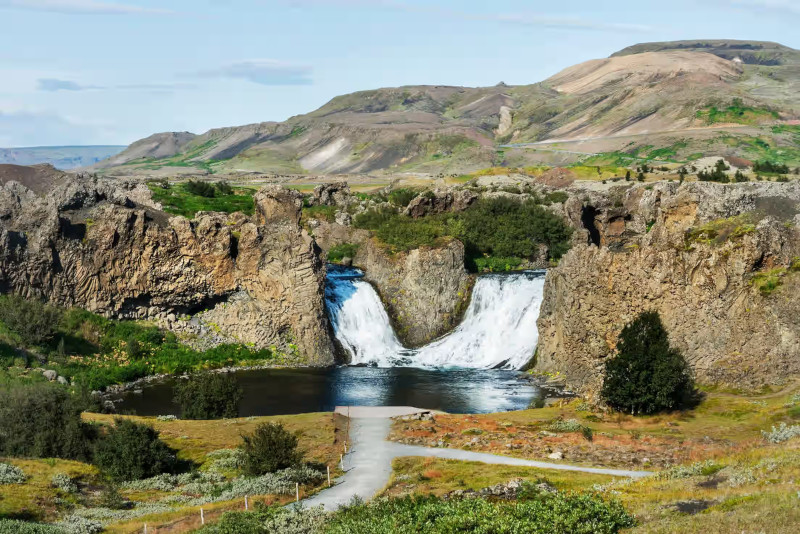
12. Kálfaströnd Farm and Höfði Peninsula (by Lake Mývatn)
At the mentioned farm, in Season 3, Jon camped with the Wildlings in the northeast of Iceland near the volcanic lake Mývatn and the Höfði peninsula when he tried to gain their favor.
Here, too, you'll find many rocky formations that Icelanders say are petrified elves. See what the Höfði peninsula by Mývatn looks like in reality on this website.
13. Grjótagjá Cave
And what happened next, you probably already guess. Who wouldn't remember the scene from Season 3 where Jon and Ygritte hide in a cozy cave... and have some fun together? Jon enjoyed intimate pleasures with Ygritte in this lava cave with a thermal spring.
And if you didn't know, their actors are married, so the chemistry between them apparently worked even off-camera. Check out the Grjótagjá cave with a thermal pool on this website.
14. Dimmuborgir Lava Field
And we'll stay in Season 3. East of Lake Mývatn lies a large area of lava fields. It consists of various volcanic caves and rock formations that resemble the ruins of an ancient fortress. The lava tunnels were formed about 2300 years ago from a lava lake.
Here, the leader of the Wildlings, Mance Rayder, had his camp, where Jon was also brought—to decide whether he would become one of them or be executed.
Dimmuborgir is one of the most popular tourist attractions in Iceland. Check out the Dimmuborgir lava field.
What Can I See from Iceland’s Fauna and Flora?
Icelandic flora probably won’t excite you much. There are almost no trees in Iceland, and plants are only in very limited quantities. However, what Iceland lacks in plant life, it makes up for in the animal kingdom. In the eastern part of Iceland, you can encounter reindeer; in the west, Arctic foxes; along the coast, seals. In the summer months, beautifully colored puffins on the cliffs and headlands along almost the entire coast, and whale-watching trips.
Iceland is home to countless species of animals, but only a few of those that attract tourists, travelers, and photographers from all over the world. These are mainly puffins, whales, seals, Arctic foxes, and unpredictable reindeer.
Puffins (listed clockwise along the coast)
1. Near Reykjavík, the islands of Lundey and Akurey,
2. Stórhöfði on the island of Heimaey (with the largest nesting puffin population in the world),
3. The cliffs at Dyrhólaey,
4. Reynisfjall Hill,
5. The Ingólfshöfði Reserve, accessible by tractor ride,
6. The islands of Papey and Skrúður,
7. The rock of Hafnarhólmi (Borgarfjörður Eystri),
8. The eastern coast of the Tjörnes Peninsula,
9. The islands of Flatey,
10. The island of Grímsey (Dalvík),
11. The island of Grímsey (Drangsnes),
12. The island of Vigur,
13. The Hornstrandir Peninsula,
14. The Látrabjarg Cliffs,
15. The islands in Breiðafjörður.
Various Whale Species
Just board a boat and head out to watch whales from Reykjavík, Grundarfjörður in winter (Orcas), Ólafsvík in summer, Hólmavík, Dalvík, Akureyri, and Húsavík, which is nicknamed the capital of whale-watching trips (good marketing:). Also, if you travel from Dalvík to the island of Grímsey, you have a good chance of spotting whales or dolphins as part of the ferry price.
Seals
1. Ytri-Tunga Beach on the Snæfellsnes Peninsula,
2. The Vatnsnes Peninsula (Hvammstangi, Hvítserkur, Illugastaðir, and Svalbarð),
3. Litlibær (Westfjords),
4. The Glacier Lagoon,
5. The Diamond Beach.
Arctic Foxes
You can see them with great luck almost all over Iceland, more commonly in the northwest, and certainly on the Hornstrandir Peninsula or at the Arctic Fox Center in Súðavík.
Reindeer
Their symbolic center is Mount Snaefell; the farther you are from it, the lower the chance you’ll see them. If you do see them, you’ve had your lucky day.
Mosquitoes
They’ll find you more than you’ll find them.
Can I Go to Iceland and Save Money?
During the main tourist season, many more people visit Iceland than in all the other months combined. And during that time, prices for accommodation and car rentals are really inflated to dizzying heights. Outside the season, prices can be up to a third lower, and the Iceland experience can be the same. And lava fields dusted with snow in winter look even better than in summer. For inspiration, a two-week trip to Iceland, including flights, a rented car, and accommodation, cost us 15,000 CZK.
With at least two months’ notice (of course, more is better), you have the opportunity to secure pleasant accommodation in a nice place at a reasonable price even during the main tourist season. Don’t rely on last-minute deals; for example, in Reykjavík during the main tourist season, you won’t find a room for less than 5,000 CZK/night.
Europeans have the wonderful advantage of being able to come to Iceland on their own wheels thanks to the Faroese company Smyril Line (and even treat themselves to a stopover on the Faroe Islands). In addition to the fact that the travel experience itself is beautiful, with a longer stay, you can save a lot by using your own car. Car rental prices start at 1,500 CZK/day for smaller cars in season, go up to 2,500 CZK/day for cars like the Dacia Duster, a breathtaking 4,500 CZK/day for a campervan, and up to 10,000 CZK/day for an off-road vehicle like a Land Rover Defender.
In Iceland, there are two websites where you can rent a car directly from locals: Carrenters and Caritas. Even though the prices may not seem significantly lower, the big difference is in the approach. The conditions are more favorable, and most renters won’t mind a few scratches (they won’t even notice which ones are from you and which were already there). A big difference compared to car rental companies.
There are dozens of geothermal pools in Iceland where you can bathe in thermal water completely for free. The Blue Lagoon is made the Blue Lagoon mainly by marketing, and if you’re not an influencer and don’t need to post your selfie from the Blue Lagoon to your followers, you can safely skip this location.
First, the two mentioned supermarket chains are synonymous with cheap everyday shopping in Iceland. (In them, you can buy groceries and not have the feeling you’ll get in smaller shops elsewhere in Iceland that there’s a food crisis.) However, know that these supermarkets are not on every corner, and the longest distance between two of them is 458 km (Selfoss-Reyðarfjörður). So it’s important to plan, especially before traveling to the Highlands or a longer stay on the south coast. If you have a Costco card, you can happily shop at the recently opened Costco supermarket in Reykjavík.
In Iceland, it’s always kind of cold, and if you go in the main season, you can buy equipment at off-season sales. Warm pants for 500 CZK or a waterproof and windproof jacket for 1,200 CZK—don’t miss out!
Lopapeysa, one of the most visible symbols of Iceland. Its style and, above all, practicality will enchant you—it can be worn in summer and winter and will warm you even when wet. Plus, it’s washed by rolling it in the snow and letting it dry in the wind. If you don’t mind a second-hand approach, you can usually buy it much cheaper than new in Red Cross stores. Not only will you save money, but the money also goes to a good cause.
If you plan to spend some time in Reykjavík, the Reykjavík City Card might be a great choice for you. With it, you’ll have free entry to selected museums, a boat trip to Viðey Island, a visit to the zoo, city bus transport, and also free entry to thermal pools. It’s like a magic card.
Even though the era of discount coupons is over, two websites in Iceland still operate on a similar principle. The classic discount site is Hópkaup, where you can occasionally find, for example, a whale-watching trip or diving in Silfra. More interesting for tourism is the website 2fyrir1, where, as the name suggests, you buy 2 for the price of 1, and you’ll find a pretty good selection of meals in restaurants.
If you plan to stay in Icelandic campsites for more than 6 days, the local Campingcard might be useful for you. It allows you, within the price (159 euros), to spend up to 28 days in selected Icelandic campsites for two people. The only thing you then pay is the tourist tax (333 ISK/day).
P.S. There are a few places in Iceland where you can legally stay for free, such as Gata campsite and the campsite by Lake Langisjór.
In most campsites, you’ll almost always find some food left by previous guests for free. And the more in-season and the closer to the airport, the more interesting things in greater quantities you can find there. For example, in the Grindavík campsite, there are so many gas cartridges in the kitchen line that a whole regiment could be equipped. In addition to cartridges and food (pasta and Chinese soups in unlimited quantities), you can find everything possible and necessary, from hammers, sleeping mats, tents, hammers, and binoculars to stuffed animals. And once I even spotted two cans of BEER! (but it was Heineken, so I left them there).
If everything is expensive in Iceland, then it’s doubly true for alcohol (and tobacco products). If you indulge in this human vice, I recommend bringing the allowed amount from the customs area. If you arrive by ferry, there’s a shop there where, in addition to hard alcohol, you can buy Faroese beer (I recommend the green cans—on sale here here). At Keflavík Airport, you can buy everything without any problems even after arrival.
I have itineraries prepared for you.
Don't want to search for places? I have a big overview of travel plans for you
